Archives

June’s A Jumpin

I was talking with a friend this morning and I reviewed the list of things that I would be doing today, it goes something like this:

Breakfast, coffee, devotional, animal chores, plant crop of corn, cook breakfast for this kids, start them on their school work, process 30 pounds of strawberries, laundry, mop and wipe down kitchen after making jam, cook lunch, help kids with more school, clean up, work in garden till 6, cook dinner, eat dinner, clean up dinner, help with evening chores, bath children, shower, and pass out!

As I look at that list, a few things change from day to day, like I might weed instead of plant corn, or process beets instead of strawberries, but this is my day.  No wonder I do not have time to keep my blog up to date!  The difficult thing with never leaving work is you never leave work.  I never get to say “Ok, Im done for the day”.  The minute you do that a chicken gets out or someone throws up.  I do however, need to find a way to write more.  So here I am relaxing, thank you for listening.

The pigs have arrived!  They are doing great, we were able to move them out of their baby pen and into the field this week.  They are loving the grass and the open space.  Their names are Ketchup, Mustard and Relish.  We keep saying that we are going to have a race, like they do at the baseball game but it has not happened yet.  These pigs are just as sweet and lovable as our last ones and we are just head over heals in love with this breed.  It is looking more and more like pigs will become a forever animal on our farm.  Within the next year or two we will get a breeding pair to guarantee we always have this breed around.


We are almost down with our spring meat birds.  One batched has already gone to butcher and the second batch will go in about 2 weeks.  This is the first year we have really been able to put them out on pasture and we are, as always, learning new things.  The major learning curve this year has been predators.  We have lost many birds, to raccoons and fox this year.  The fox is continuing to be a problem, we have trapped some, but electric fencing around the outside of everything seems to be our only solution.  We have added many small fence chargers for the moveable bird pens and for the pigs and goats.  This seems to be working but we still live in fear.

Lastly, we are happy to announce that we received our cost share grant from  Soil Conservation.  It has been a long, very long process and we are not done yet, but they did tell us we have been approved.  We are excited to start the next step which is planning, estimates, building and yet more paperwork.  It is worth it!  I can not wait to be able to open up those fields and let the animals run.

Alright, enough relaxing for me, time to start chores.  I hope you have a great day!


April 2016 Goings on

I will be honest with you, keeping up with the farm has been a challenge.  My foot really has slowed me down and limited what I am able to do everyday.  Now that it is starting to heal and that the weather is getting warmer, it is time to just push through.  Our day starts at 4:30. Before the sun comes up, I start with the paperwork for the farm and my bible/prayer time.  Once the sun is up the animals start calling to me.  The day comes to an end when everyone is locked back up safely in their pens around 8 pm.  In the middle of the day we address whatever problems come up, clean pens, collect eggs, homeschool the children, cook 3 meals a day, clean the house and plant the garden.

There have been several additions to the farm, we currently have 60 meat chickens, 10 turkeys, 5 ducks, 5 rabbits, handful of tilapia, 3 goats, and 36 laying hens. Within the next week we will have 2 liters of bunnies born, 3 baby pigs arrive and 5 more turkeys will be coming.

ncm_1683.jpg

We are also in the process of putting in a garden.  The soil is so bad, we are having to bring in truck loads of compost.  It is costing a lot of money, but so does buying groceries.  We are hoping and praying that the investment pays off and the need for the grocery store will be greatly reduced. So far we have had 21 yards of compost delivered.  I do not think that it will be enough and we are going to need more brought in.

Our world is crazy, but it is a good crazy. We are learning new things everyday.  Some days are good and some days are bad, but all in all we feel very blessed to be farming.


Buying a side of Pork

So we are starting a new chapter on the farm, we are selling sides of pork.  We loved raising pigs last year and this is something we are going to expand on.  I hope we continue to love it!


Pork Cuts Vintage Vintage blackboard cut of pork

the picture is from imgarcade.com

This is the email that I sent out to inform people about what it means to buy a side of pork.  I hope that it is helpful to you as well, even if you do not buy from us.

Hello,
Thank you for expressing an interest in buying Pork from our farm.  This email has a lot of information in it but if you still have questions please feel free to call me.  Most of the people that we sell to are friends and family or friends of friends and family.  We love you all and will not judge you one way or another if you decide not to buy from us, this is not for everyone, we understand that and will continue to love you no matter what!

About our Pigs: Our pigs are Gloucestershire Old Spots, a heritage breed of pig that is an original homesteading pig breed from England.  These pigs were almost extinct in 1990 in the United States but are making a come back now through awareness and education.  This breed thrives on pasture, has an amazing personality, is easy to handle and the meat tastes great!  We raise our pigs on grass, not concrete like most pork is raised.  They play in the mud and sunbath.  They are given as much pasture as they want, but are fed grain as well, they are not 100% pasture raised. They are also given treats like veggies from the garden and they love apples and watermelon.

When buying a half an animal you pay the farmer for the animal, the farmer transports the animal to the butcher for you, and then you pay the butcher for the custom processing.  Buying pork in bulk can sometimes be confusing, especially if you’ve never bought your meat this way. You want to think about what cuts of pork you and your family like to eat. In the Spring, you might be thinking about grilling meats, but remember to think ahead to the fall and winter when you might cook more roasts and stews. The butcher vacuum packs the pork and it will keep in the freezer for a year or more. When you buy a side of pork, you are the one that calls the butcher and tells them how you want the meat packaged and processed.  How big do you want your pork chops?  How many pounds of ground pork do you want in one package?  How big do you want your roasts / ham?  Do you want it cured or left uncured?  Buying this way gives you more control over your food.

Lets talk Money: The cost is $4.25 per pound of hanging weight to the farmer (which is me!), and the custom processing costs to the butcher.  The processing costs varies slightly depending on what you want but it is about $80 give or take depend on the size of the pig. The price is based on the hanging weight of the pig, which is the weight after the head, feet and organs have been removed, but before it has been butchered into usable cuts. We estimate that the hanging weight of a side of our pork will be between 70 and 100 lbs. That equates to about $400 for a side of pork, plus the $80 to the butcher. Add those together and that is the per pound cost of the meat.  To compare it to the cost at the store, look at the price for a pork loin, ground pork, bacon, ribs, ham and chops; average all that together and you will get an idea of how the price per pound compares.
You pay $200 now to me as a deposit and the remaining $4.25 per pound to me when we find out the hanging weight.  You pay the butcher directly when you pick up your meat.

Cuts of Pork
There are five specific sections to a hog, two of each section if you’re buying a whole hog, or one of each if you’re buying a side:

– Loin
– Belly
– Ham
– Shoulders
– Ribs

This is a rough picture of what you can get, it changes depending on the size of the pig and how you want it processed: 6 pounds of bacon, 7 pounds of rope sausage, 16 pounds of ground pork, 6 pounds of shoulder roast, 4 pound loin, 9 pound ham, 4 pounds ham steaks, 9 pounds pork chops, 1 smaller pork loin, 4 pounds spare ribs, 1 1/2 pound spare ribs, and 1 1/2 pound baby back ribs.

Ok, I know that was a lot of information.  Please, please let me know if you have any questions!  I currently am picking up 3 baby pigs at the end of April.  I already have 1 1/2 reserved.  If you are interested please let me know so I make sure I have enough.

Pigs

As always it was been way too long since I have written an update.  Today’s blog post is purely a couch therapy session with World Wide Web.  Thank you for allowing me to get this morning off my chest!

ncm_1221.jpg

Our fabulous pigs are finally old enough and big enough to go to slaughter.  They had such a great personality and were so sweet, but their size was really starting to become a problem.  They are very, very strong animals and ours had behaviors similar to dogs.  When we went into the pen to feed or water them, they would rub on you and go between your legs, or lean into you.  Well, 275 pounds of pig leaning into the back of your knees makes it difficult to stay on your feet.  That was just if one of them came over, when they both wanted attention and to love on you, it was down right dangerous, our son was knocked over and it was very scary.  In addition to their size, they really do not like the cold weather or the snow.  It became difficult to get them water and we have not been able to move their pasture so the mud was getting too deep for my liking.

So it is time to slaughter!  We had made our appointment months ago, we had no idea what the weather was going to be or what would be going on in our world on the day of slaughter.  Last week I found out that I have a torn tendon in the same foot I just had reconstructive surgery on. I am back in the fashionable walking book cast thing.  Not really where I planned to be 6 months after my reconstruction surgery. In addition to me not being 100% there was a winter storm warning in effect for our area.  Not really the ideal time to take a trailer back into the pasture in the mud and haul pigs out. So this combination was stressful enough. To add to the stress, when we borrowed the trailer from a friend, we decided to also buy 90 square bales of hay to stock up until after spring.

So the pigs are suppose to go to slaughter on Tuesday morning no later than 8am.  Monday morning we wake up at 430am we looked at the forecast like every good farmer and see that the rain/ice/snow event is not suppose to start till after dark Monday night.  Perfect.  My husband can go to work, when he comes home we will unload the hay from the trailer and load the pigs before dark, perfect plan.  WRONG!  When I checked the weather again at 930 the timeline for the storm moved to 3pm and the fields were already muddy from the melting snow.  Great, by the time we unload the hay tonight, the fields will be a complete slip and slide.  There is no way we would get that horse trailer out.

So me and my fashionable boot had to unload the hay bales so that my husband could focus on getting the pigs in and the trailer out of the field ASAP when he got home.  Luckily, I had some help unloading the trailer, but it was still hard on my foot.   My husband arrived after work and with the help of another friend were able to get the pigs on the trailer much smoother than we imagined.  Getting out of the muddy field was a struggle, but even that happened easier than I thought.

ncm_1293.jpg

OK now the pigs are happy and on the trailer for the night.  We were suppose to get ice and snow all night.  When we woke in the morning we were thankful to see that the roads were not covered.  We loaded the kids in the truck and off to the butcher we went!

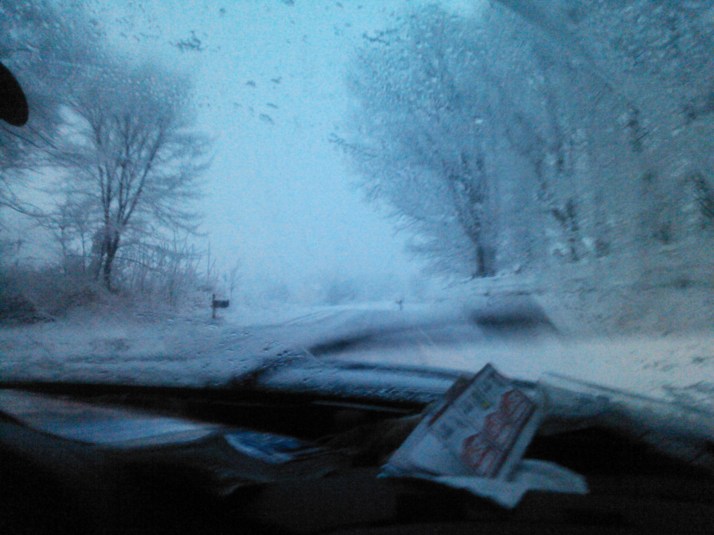
This is when the nightmare happened.  Apparently, we were in a warm patch, because when we got 5 miles west of our small farm, the roads were covered with snow and ice.  It was still dark out, the snow was falling so fast you could not see 10 feet  in front of the truck and there was so much ice and snow on the ground that we could not stop.  There was several times I saw the rear trailer lights in the side view mirror.  There was a couple times we were on the wrong side of the road because of a slide and low visibility. We missed our turn and ended up going 25 miles out of our way because the roads were so bad that we could not stop to turn down a side street without jack knifing the trailer.  The butcher is normally 30 minutes away it took us an hour and a half to get there.

ncm_1295.jpg


Once we arrived we were not out of hot water yet, there was no open holding pens for the pigs.  We had to wait for 30 minutes or so for them to be able to go in.  This was a blessing though.  Our babies were in the trailer, sleeping  and getting extra love right up until the time they went into the “back room” area.  They were never under any stress or had any fear of what was going to happen.  They were completely relaxed to the point of snoring up until moments before their lives ended.  That is exactly how I wanted it to be.

Now we have dropped off the pigs.  We are still 25 miles from home and it is still snowing really hard.  Luckily the sun had come up at this point.  The first 20 miles of the ride home was very uneventful.  We took a Southern route home which made a big different in road conditions.  About 5 miles from the house, the alternator goes up on the truck.  We have to get home in the snow with whatever battery power we have left.  Of course we hit every stop light possible in the 5 mile stretch.  Finally we made it home, three and a half hours later!  We were all stressed.  I made another pot of coffee and sat down to vent to you.

1444924123.jpg

Thank you for this therapy session, I needed to get it all out!  It has been a roller coaster ride.  I am glad we are all home safe and we are going to have a quite day to allow our blood pressure to go down.  I hope you stay safe this winter and I will write again soon.

Farm Set up and Soil Conservation

Quick Update

So we are still working on the farm and right now just trying to keep a float, literally as the rain comes down.  With my foot still healing most of the work on the farm has to be done by my husband.  He is fabulous and works really hard, but it does not allow us much time to start new projects.  At the new farm so far, we have the chickens in a new chicken coop and yard. The inside of the coop needs to be remodeled, but it is functional and for the most part dry.  The goats are in a structure made from a recycled dog run roof, pallets and weed cloth.  They are also for the most part dry.  The pigs are in a moveable run in that we are moving around our field, until we get permanent fencing up.  The ducks are happy in the rain, the rabbits are dry in their barn and the tilapia are warm in the basement for the winter.

ncm_0926.jpg

Soil Conservation

Now that you are caught up with general goings on, let me talk about Soil Conservation.  Soil Conservation is a government company that can help a farmer establish and improve pasture rotation practices to improve soil quality.  Pasture rotation is when the livestock are moved to different fields on a rotational basis.  This allows one field time to recover while the animals are grazing on another field.  The pasture sizes depend on the type of animal you are raising and the number of head.  For example, we are raising a small amount of animals, at most 10 pigs or chickens, our pasture fields will be broken up into small fields 1/2 acre in size.  These fields all need a structure and water for the animals.  Soil Conservation can help new farms create a pasture rotation plan as well as apply for a grant to be able to help with some of the cost.

Phone pictures end of may 2015 282

995.127.1

We are just beginning that process with them. Below is a check list of what you need to get started.

  • Own the land you want to farm.
  • LLC or Sole Proprietorship
  • Employee Tax Identification Number (EIN)- This number can be obtained through the  IRS.
  • DUNS number- http://fedgov.dnb.com/webform
  • Contact your local Soil Conservation Office- Search Soil Conservation and your state name.

The Soil Conservation office will send you an application as well as set up a time to come out and look at your property.  So far everyone I have dealt with has been very nice and they will be visiting the property next week.  I will keep you posted on what happens.  We are hoping to get fencing, water, and structures put up within the next year.  Who knows what God has in the plan for our little farm.

In the mean time, I am resting inside trying to get as much of the administrative stuff taken care of on the farm.  I hope this was helpful.


Still Learning

I wanted to set the record straight, right here and right now.  I know nothing about Homesteading! My husband and I have a dream.  We want to be food indepenant.  We want to live simplier lives and be good stewards of the gifts that we have been given.  This dream has grown and changed over the years leading us to where we are now, a small homestead.  Our dream has been fueled by fellow bloggers, Mother Earth News, YouTube, food sensitivities and a general love for dirt among other things. After growing food, composting, raising chickens, rabbits and fish for the past 3-5 years, I think it is still safe to say we have no idea what we are doing. 
I watched a documentory about Market Gardening and the woman said “how do you become an expert at something you only every do, maybe 50 times”.  That really resinated with me. Think about it, we are in our 30’s right now, if I grow potatoes for the next 50 years I will have only grown potatoes 50 times.  It is said that it takes doing something 30 times for it to become a habit.  How many times do you have to do something to become an expert? I am certain that I will never stop learning and I will never be an expert.
Now that we own our dream homestead, everything we are doing is new.  Even silly things like planting in the ground… I have never done that.  The only successfull gardening I have ever done has been in raised beds.  I do not know how to plant seeds in the ground!  This year is a perfect example of that inexperience.  All of our plants died.  I did not know to ask the previous farmer how much fertilizer he put on the field this Spring.  Who would know to ask that, it was just field grass. Well, weeks before we took over the property, he put the strongest fertilizer you can buy on the land and killed all my seedlings.  I just thought, “wow, you are really bad at this planting in the ground stuff”.

image

Currently, we have 46 chickens and 7 ducks.  I have never owned this many chickens.  I honestly have no idea what I am doing.  We have read all the books, gone to workshops, researched online, but when it comes down to it, we have never done this before.  At this point I am just praying we do not get the bird flu and lose all our birds.
Within 3 weeks of closing on the farm, I decided it was the perfect time to get baby goats.  We have never owned baby goats, we had no structure to keep them in and no fences, we obviously needed goats.  I know nothing about goats, this is a fly by the seat of your pants, learn as you go operation.  With a lot of hard work from my husband, I can now say the goats have a great run in building and a fenced in yard. Currently are doing very well, but I have no idea what winter will bring.
Before closing on the farm, I contacted a pig breeder, because what you really need when you move to a farm with no buildings and no fences and no idea what you are doing, is pigs.  The pigs arrived a month after the goats and here it is 1120 at night and I am up researching how to raise pigs.  They are currently 5 months old, some people would have tried to figure things old before they bought them, but I am a fly by the seat of your pants kind of girl.

image

So consider this your warning.  If you are coming here for experience and absolute education, this is not the site for you.  If you would like to come along side my family as we learn, please take my hand and we can jump in together. 

Rabbits Final Post in Series

Ok, despite the curve balls life has thrown me, I will finish this series on rabbits!

image

I have talked about how to choose a rabbit and how to bring it home now we need to talk about what to do with it once you get it!

Depending on the purpose of your rabbit, this might be where you can stop in this series.  If you are bringing your rabbit home as a pet, enjoy your new family member! 

image

If you are starting a rabbitry to breed and sell rabbits or to consume rabbits, your journey will continue on. I have found the sale of rabbits to be hot and cold.  There are times when I can not breed the rabbits fast enough.  There are other times when I have 18-20 growouts and no idea what am I going to do with them all. 

Those of you that are interested in raising them for meat.  That will not be a problem for you.  You can start breeding your rabbits around 6 months of age, depending on the bred.  The smaller breeds need to wait longer before they are bred for the first time.  The gestation period for a rabbit is anywhere from 28-31 days.   Litter sizes also depends on the bred and the breeding practice.  We can talk about the details of breeding in another post.  Going back to meat, you can usually process your rabbits for freezer camp around 4 months depending on the bred and the size you are going for.

Like I mentioned earlier, I do not raise or rabbits for meat. For this reason, I only breed our animals once or twice a year.  I am interested in the preservation of the breed and in the manure benefits. To find customers, our rabbitry is registered with ARBA and a couple other rabbit breeder websites.  Occasionally, when I have rabbits for sale, I will list them on Facebook or Craigslist, but for the most part, the people that I sell to find me because they are specifically looking for American Chinchillas.

Other profitable rabbitries sell to dog food companies, butcher shops, 4H clubs, and pet stores for snake food.  There are many different avenues if you are interested in selling rabbits.  To be totally honest with you, I do not make much money selling our rabbits, I make enough to help pay for their food costs and my rabbits give me amazing fertilizer. 

image

Love your rabbits and enjoy them.  I am amazed everyday by what wonderful creatures they are.  I personally think rabbit are a great addition to any homestead. I hope you found this series informative, if there is any questions that I did not answer please let me know, I am happy to share what little I know.

Raising Rabbits 2/3 in series

In the first post of this series I talked about what questions you need to answer before you get rabbits.  If you are still reading, I am assuming that you have decided that rabbits are still a good fit for your family.  I can’t blame you, I think that they are fabulous. 

image

In this post I am going to talk about how you choose the right rabbit and bringing it home. 

One of the questions that you answered in the first post is why you want rabbits.  If you are looking to homestead, like I do, than you are interested in a rabbit that is breed for meat and possibly for fur.  There are many meat rabbits out there that can supply your family with a steady supply of food.  The breed that I choose was American Chinchilla.  The reason that I choose that breed was that I wanted something that was a heritage breed.  The heritage breed animals seem to be a much better fit for a homesteader.  They produce a good size roaster and are a very good with kids.  Those are two very important things to me.  A breeding trio will provide you with a constant supply of meat.  A trio is made up of two doe rabbits and 1 buck. You want the two does to be two generations removed from the buck or unrelated to the buck.

If you are interested in rabbits because you would like a pet, there are a lot of smaller rabbits out there that are not as large as the American Chinchilla.  I have found that some of the smaller breeds can be a little grumpy.  If you are looking for a pet, please make sure that you have the time to socialize it, so that you have an animal that can be handled. Lastly,  I would not be an animal lover if I did not plug the local animal shelter.  If you just want a pet and compost, this might be a great place to look. 

Another reason to have rabbits is for fiber.  Do not tell my husband, but this is my next adventure.  I love the angora rabbits.  They provide you with fiber a couple of times when you shave them.  I love that this is a renewable resource, unlike the rabbit fur, which is a one time use only.

No matter what your reason for getting a rabbit, this is a great place to research some great breeds of rabbits.
http://www.livestockconservancy.org/

Once you decide what breed you want, you can go to the American Rabbit Breeders Association Site to find lists of breeders by state.  While you are on the ARBA site, if you are interested in showing rabbits in 4-H or another organization, please get the show standards book.  This makes you an educated consumer.  I, for example, do not show my rabbits.  When I sell a rabbit, I know that it is pure bred American Chinchilla, it has a good attitude and then I focus on breeding ability and health.  I know nothing about showing.  My rabbits are easy to handle, clean, in good health and come with papers, I depend on the buyer to know which rabbits are good show rabbits. 

image

Look over your rabbit when you buy it, you want it to have a clean bottom, clipped claws, clean ears, nice teeth, and bright eyes.  Feel the rabbit over, make sure you do not feel any bumps or scabs.  I actually was selling a rabbit, and even though I interact with my rabbits often, I did not notice a bump her side.  The seller helped me find this abscess before it got worse and I was able to get the rabbit to the vet.  This was a rabbit had gotten out of her cage and apparently been bit by a tick.  The bite got infected.  I was able to get her treated and now she is a healthy rabbit.  You want to find a breeder that cares about their rabbits. 

BRINGING THEM HOME
Before you bring them home make sure you have your water  bottles, feeders, hay, cages, and rabbit feed.  You might even want to talk to the breeder about rabbit feed.  If you have more than one feed available to you, the breeder might be able to point you to one they found worked better than another.  We prefer Blue Seal Show Hutch Deluxe.  My rabbits love it and I recommend it to all my buyers.  Before you leave the breeder make sure they give you a small bag of whatever they are feeding so that you can slowly transition the rabbit to their new food.

Actually bringing them, a cat carrier is a great way to transport your rabbits.  Another great way to transport is rubbermaid totes with holes drilled in them.  We did a mix of the two.  You can transport the does together in one carrier, however, you need to make sure each buck has their own carrier. They will fit if you put them in the same box. 

Just like with bringing the rabbits home, once they get home you have to make sure that they bucks have their own cages.  The does can share a cage while they are young, but once they reach breeding age it is important that everyone have their own cage. 
 
After your rabbits are home, make sure they have water, but I have learned to with hold food for a few hours.  Let the rabbit get settled from the car ride before you offer them food. 

Now that you have your rabbits, the next post will be some basic management and lessons that I have learned. 
Always end with cuteness!

image

Raising Rabbits Part 1/3

This is a three part series on raising rabbits.  Hopefully we will have the whole series published by the end of the week. This first series is about where to start..

When deciding if raising rabbits is right for you, it is important to answer a couple questions first.
Why do I want to raise rabbits?
How much space do I need / have?
What am I going to do with the babies?
Do I have time?

There are many reasons to want to raise rabbits.  On a homestead they are very valuable.  Some people raise rabbits for meat, some raise for show, some raise for manure and some raise them as a pet. 
We originally started raising rabbits for meat.  We had tasted rabbit meat and liked it.  We wanted to become protein independent, rabbits are a great way to do that in a urban setting.  When it came time for us to cook our first rabbit, I got a horrible migraine.  I occasionally suffer from migraines so I did not think anything about it.  The second time, I suffered from another migraine.  The third time I was not home when the meat was cooked.  I enjoyed it for dinner and did not have a problem.  I attempted to cook it myself again and was sick again. When I did some research I found out that some woman get migraines from rabbit meat.  It has something to do with hormone levels.   We have since decided that rabbit meat is not for us.   Even though we do not raise our rabbits for meat, they are invaluable to us because of the compost they produce.  The soil is rich, and my tomato plants grown in rabbit manure were 10 feet tall.  You need to ask yourself, Why do I want rabbits?

Depending on why you want rabbits you need to consider the space that you have.  A rabbit needs a cage that is 3 foot by 4 foot.  This is a minimum  in my mind.  We are also looking for ways to get our rabbits more space.  Also, when rabbits have babies you have to have a place to put them.  Males and females need to be in different cages.  We have two grow out hutches and runs. Below is a picture of one of our runs.  We do not keep them in the run at night and we do not keep them in the run in the winter.  This is a summer exercise area for us.   

image

There are many ways to build your rabbitry.  It is important to make sure that the rabbits have shade, enough space and protection from the elements and predators.  We have built our cages inside a 10×8 shed.  There are 4 female cages on one side of the shed and 4 male cages on the other. 

image

Under the cages we have ramps with linoleum flooring so that it is easier to keep clean. 

Next, you have to know what you are going to do with the babies.  If you are raising rabbits for meat then you know the answer to this question.  If you are raising them for show or as a pet, the answer is not as clear.  We are not raising our rabbits for meat so we only breed them twice a year, based on demand.  We sell our babies to other people that are interested in homesteading, 4H or just want a pet.  We only breed for what we have found out we can sell.  The breed that we raise, American Chinchillas, are an amazing bred.  We have taken time to get a great blood line, and we want to be a part of the come back of this breed.  If you only want a pet and you do not want babies, take the rabbit to vet and get it fixed.  It is important to understand the purpose of your rabbits.

Lastly, you need to evaluate if you have time for rabbits.  The way we have our rabbits set up, we have about 1/2 an hour worth of rabbit chores a day.  Every two weeks or so we spend a couple hours with our rabbits.  We take them out, do health checks, clip toe nails, brush, and give the cages a good cleaning.  Make sure you have enough time to give the animal the care that it needs. 

In addition, we are going to add the cost of rabbits.  You can build rabbit cages out of scrap and spend next to nothing on them.  We put ours in a shed, so we had to buy the shed, buy the wire and build the ramps. That was our choice, rabbits do not need to be in a shed.  On average a 50 pound bag of feed cost $20.  Once a rabbit is 6 months old it should only get about a cup of feed a day.  We supplement with hay, which we get for $3 a bale.  We have had to take the rabbits to the vet twice.  It was under $100 each time.  Other costs to research is a tattoo kit, water bowls, feeders, nesting boxes, clippers, traveling cages, show stand, ARBA membership, and bedding if you use it.  Our rabbits are also litter trained, because we want to get as much of that compost as we can, so we buy bedding for the litter boxes.  Brain storm the type of rabbit set up you want and figure out the cost of your rabbits before you get started.  

We love raising our rabbits, we have found that it is worth it for us.  If you need more information on raising rabbits we encourage you to read Storey’s Guide to Raising Rabbits.

The next post in this series will be which animal to choose and how many!

Farming from the Couch

Last year I fell and broke my foot.  I than re-injured it in the winter when I slipped on ice.  I was really hoping that it would heal. I was a good girl and used ice at the end of the day and took anti-inflammatory medications.  In the end of a 5 month attempt to heal, the doctor told me reconstruction surgery was the only way I could get better.  He even told me that if I had another serious sprain, I would be facing an ankle fusion.  All that being said, I had my surgery a week ago.  It will be 3 months before I can walk or drive and possibly longer.  Most people are able to walk on their own without crutches at 6 months.  I have a long road ahead of me.

Just because I am down and out does not mean that the farm stops.  We have 3 goats, 2 pigs, 50 chickens, 7 rabbits, 50 tilapia, 7 ducks, 3 cats and 3 dogs that do not care if I can walk or not.  This kids are a major help, the community is pitching in and my husband is a saint.  

image

My job on the farm has drastically changed.  I am researching grants to help our farm grow, I am planning our garden layout for next year, I am going to blog more about food, crafts and the farm, and I am organizing help for the farm when needed.

I would be lying if I told you that I was happy not being so hands on.  I love to work on the farm.  I love having dirt under my nails.  However, I am going to focus on organization, my second love.  I am also focusing on our Home Made Christmas projects.  Thank you for hanging with us as we continue our farming journey.  We are trying to stay positive and look at this time as a blessing for us to get organized.